
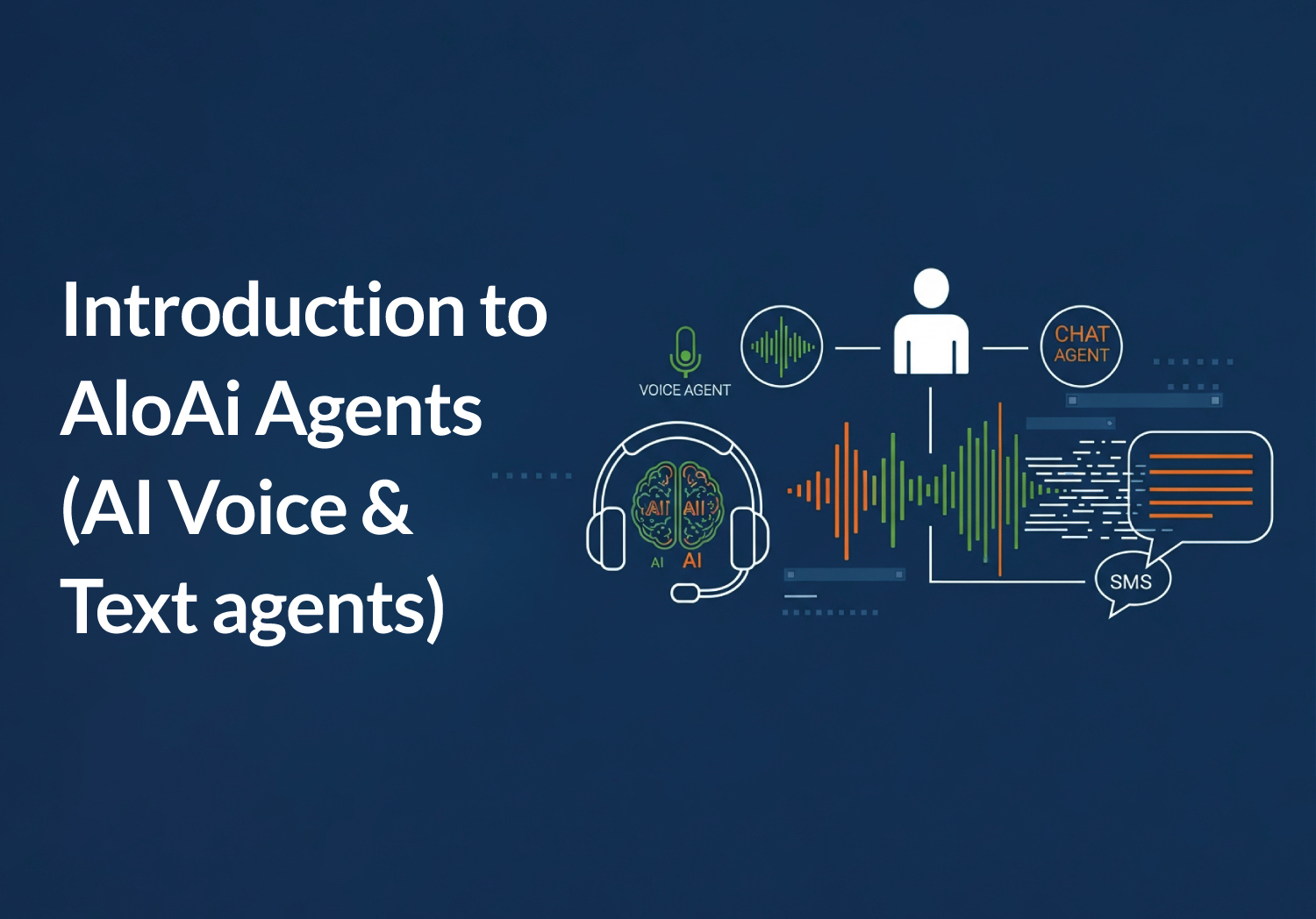


Businessesusing traditional Contact Center services face the same headaches: siloed communication, slow response times, and too much work for sales and support. AloAi Agents solve these problems with a smarter, goal-oriented AI approach built natively into Aloware’s contact center.
TL;DR
An AI agent is worth deploying when it owns an outcome rather than a reply: booking the meeting, qualifying the lead, reviving the dead opportunity.
- AI customer service shortens a response. AI customer experience changes what happens between the responses. They are measured differently and confusing them is why most AI projects stall.
- Consent comes before capability. Calls to wireless numbers using an artificial or prerecorded voice need prior express consent, and regulators already treat cloned and synthetic voices as artificial.
- Inbound and outbound are different risk profiles. Answering a call someone placed to you is straightforward; dialing out inherits every consent obligation a human rep has.
Stop chasing lost leads and juggling missed calls. AloAi Agents instantly engage new leads, re-activate old opportunities, and deliver seamless follow-up with no manual intervention, no dropped balls.
Why AloAi Agents?
Every lead, inquiry, or customer question should be handled right now, not in an hour, not next business day. Most CCaaS providers talk about automation, but they’re still dependent on rigid flows and limited scripting. AloAi Agents are different: they respond immediately, work 24/7, and use AI to actually solve the task, not just run a script.
What problem does this solve?
Your team loses deals and damages customer relationships when:
- Inbound calls and form leads sit unaddressed for minutes or hours
- Dead leads are forgotten instead of revived
- Manual follow-ups slip through the cracks
- Call and SMS histories are scattered, making it impossible to track true engagement
Competitors let you automate messages or set up basic IVRs, but they don’t own the outcome. AloAi Agents close that gap. They work toward real goals: booking the meeting, qualifying the lead, capturing information, and moving your pipeline forward, all in one place.
AI customer experience vs. AI customer service
The two terms get used interchangeably and they are not the same thing. Customer service is one touchpoint. Customer experience is every touchpoint, from the first inbound call to the renewal conversation. AI applied to service shortens a response. AI applied to experience changes what happens between the responses.
The difference shows up in what you measure:
- AI customer service: first response time, resolution time, deflection rate, after-hours coverage. The question is how fast a request gets handled.
- AI customer experience: speed to lead, qualification rate, appointment show rate, repeat contact rate. The question is whether the journey moved forward.
Bad: an insurance agency adds a website chatbot, deflects a share of its FAQs, and calls that an AI customer experience program while inbound quote calls still ring out after 5 p.m. Good: the same agency puts a voice agent on the main line so after-hours quote calls get qualified and booked, then reports show rate instead of deflection.
The same split decides where an agent belongs. A law firm intake line, a solar installer chasing aged leads, and a dental practice filling cancellations are all experience problems, not ticket problems. AloAi Agents are configured toward the outcome rather than toward closing a ticket.
Key takeaway: deflection is a service metric. If your AI project only reports deflection, it is not a customer experience program yet.
What consent rules apply before you turn an agent loose
An AI voice is not a legal loophole. Federal rules require prior express consent to place calls to wireless numbers using an automatic telephone dialing system or an artificial or prerecorded voice (47 CFR 64.1200), and the FCC has determined that voice cloning and similar technologies qualify under that statutory phrase. The Commission has since proposed defining an "AI-generated call" and requiring callers using AI-generated voice to disclose that fact at the beginning of the call (FCC proposed rule, September 10, 2024).
Answer the consent question first and the capability question second. An agent picking up a call someone placed to you is straightforward. An agent dialing out inherits every obligation your human reps carry, and a synthetic voice raises the bar rather than lowering it. We cover the purchased-list version of this question in can AI voice agents call purchased lead lists.
Key takeaway: confirm you may call the list, then decide whether a human or an agent makes the call. Reversing that order is how compliant teams end up with exposure.
How it works
AloAi Agents are AI-powered assistants embedded into your Aloware workspace. They engage contacts by voice or SMS (separately), both inbound and outbound.

Each agent is configured for a specific goal, like answering FAQs, qualifying leads, booking appointments, or re-engaging lost opportunities.

Agents use natural, free-form conversations rather than canned responses. You define the business logic and knowledge base. The agent adapts on the fly, asks the right questions, and takes action (e.g., update properties, book calls, send SMS, transfer calls) until the job is done.
Core behaviors
- Instant Lead Engagement: The moment a new lead submits a form or calls, an AloAi Agent responds across SMS or voice, presenting offers, answering questions, and scheduling follow-up.
- Old Lead Nurturing: Re-activates aged leads automatically with personalized outreach, then passes live opportunities to your human team.
- AI-Driven Conversations: Not a rigid script. AloAi Agents understand the end goal and dynamically guide conversations, collecting details, answering queries, overcoming objections, and taking next steps.
- Channel-Specific Mastery: Voice and text agents are purpose-built. Outbound and inbound use cases are designed and tracked separately for precision.
Competitive context
Businesses using Aircall, RingCentral, or Kixie see the limitations: they can automate call routing, but they can’t close the loop. They don’t natively integrate engagement, follow-up, and qualification into one intelligent flow. Aloware’s AloAi Agents handle the entire conversation, voice or SMS, start to finish, and push data directly to your CRM. This is a step-change beyond basic call bots or IVRs.
Comparison example:
- Offers an IVR and basic call routing, but can’t qualify leads or book appointments autonomously. No advanced SMS workflows. Outbound calls, appointment booking, and advanced workflows are limited.
- Basic auto-attendants and message bots, but lacks AI-driven lead nurture, follow-up, or deep workflow integration.
- Make agent setup easy for non-technical users, but rely heavily on templates. Their bots don’t adapt beyond the script. They follow instructions, but don’t work toward business outcomes.
AloAi Agents stand apart. You get:
- True multi-channel (voice + SMS) automation, built for both inbound and outbound, not one or the other.
- Goal-based conversations that go beyond scripts, adapt in real time, and complete tasks like booking, qualifying, or transferring, fully integrated into your existing CRM and workflows.
- No-code builder with pro options, so both business users and power users get the control they want, without the learning curve.
Typical user flows
Inbound Voice Agent:
Caller dials your line → AloAi Voice Agent answers → Qualifies or answers FAQs → Books appointment or transfers to a human → Logs everything in Aloware and your CRM.
Outbound SMS Agent:
Lead fills out a form → AloAi SMS Agent immediately texts the lead → Asks qualifying questions → Presents an offer or books a meeting → If no response, sends scheduled follow-ups → Escalates to human if needed.
Missed Call Handler:
Customer calls after hours → AloAi Voice Agent answers or texts back → Captures inquiry, books callback, or resolves issue → Logs the interaction for your team.
Lead Revival:
You import a list of aged leads → AloAi Agent runs a re-engagement campaign via SMS or calls → Qualifies and escalates any “revived” contacts.
Use cases
- Instant response to new web form leads, book meetings in real time
- SMS or voice follow-up with missed callers or no-shows
- Old lead revival via bulk outbound SMS or voice
- FAQ answering and simple troubleshooting over SMS or phone
- Automated appointment confirmation and rescheduling
- Legal intake and BDR/SDR lead qualification
How this fits with Aloware’s other tools
AloAi Agents are not a bolt-on. They connect deeply with Aloware’s core features:
- Use with Aloware’s calendar, call tracking, and CRM integrations (including HubSpot and Salesforce)
- Actions taken by AI Agents (SMS, call notes, tags, bookings) are fully tracked in the same timeline as your team’s manual work
- Sequence follow-ups, knowledge base answers, and real-time transfers all use Aloware’s existing communication infrastructure, no separate tool needed
What’s needed to configure?
Getting started is fast:
- Decide the agent’s goal (e.g., “qualify leads and book meetings”)
- Pick your channel (voice or SMS)
- Load your knowledge base, add key instructions, and set your action logic (e.g., which calendars to book, who gets notified)
- Customize voice, language, schedule, and engagement rules to match your workflow
- Assign to your phone/SMS lines as needed
Pricing runs per minute of agent talk time rather than per seat, so the model tier you pick drives the bill; what an AI voice agent costs breaks down the math, and the VoIP phone system guide covers the numbers and lines an agent answers on. Most businesses deploy a working agent in under an hour. Detailed setup instructions and templates are available via Aloware support resources.
Outsmart Your Competition with Al-Powered Conversations. Start 7 day free trial
.png)

Ruby Kootval is Head of Product Marketing at Aloware. She has 12 years in digital marketing, including 8 in B2B SaaS and 5 in telecom, and writes about AI voice agents, dialers, CRM integrations, and contact center operations.


